In many healthcare services, the problem is not lack of vocation. The problem is too much friction.
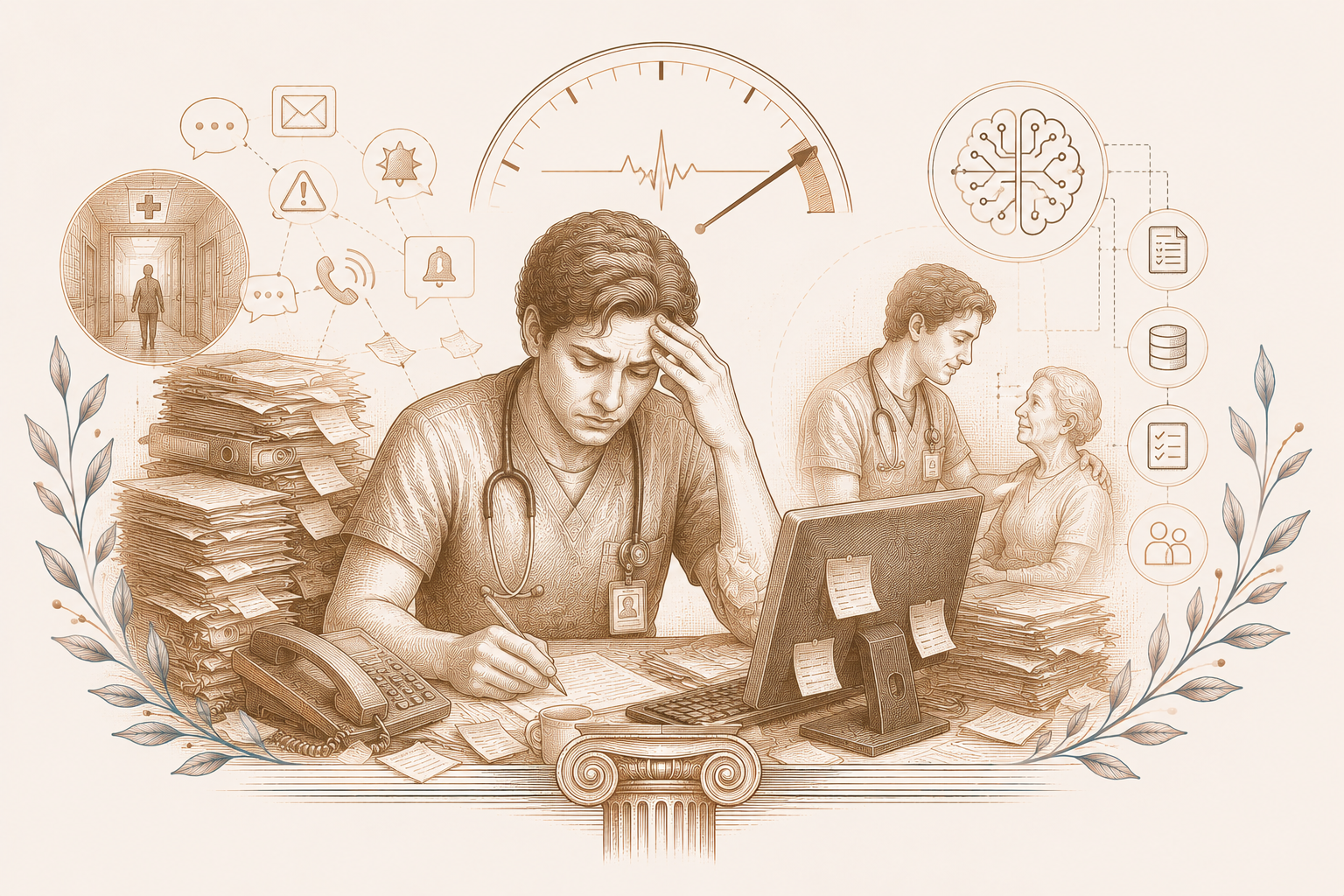
Physicians, nurses, and technical teams keep care running in something close to overclocking mode: more tasks, more open windows, more paperwork, less mental room to decide well. That forced performance may look efficient in the short term, but over time it degrades the most valuable parts of the system: clinical judgment, coordination between people, and care for those who care.
The question is not whether AI can speed up this pace even more. The right question is different: how to use it to lower the noise, organize information, and protect staff, with the goal of improving both management and patient care.
1. What medical overclocking means in practice
In technology, overclocking means pushing a processor to perform above what it can safely sustain. Something similar happens in healthcare when a team works chronically at the limit, and the most concerning part is not the occasional demand peak, but the fact that this mode becomes normal.
Too many administrative tasks per shift. Fragmented systems. Duplicated records. Alerts that interrupt more than they help. Constant pressure to document faster than one can think.
Any healthcare professional recognizes this description. Not because it is exaggerated, but because it is Tuesday afternoon in almost any service.
When that mode becomes permanent, bureaucratic load does not only take time. It also takes clarity. And in medicine, clarity is not a luxury.
2. The hidden cost of bureaucratic overload
Bureaucracy is not neutral. It has clinical, organizational, and human effects that rarely appear in management reports, but that anyone who has worked a long shift knows firsthand.
The more mental energy is spent on low-value tasks, the less energy remains to prioritize complex problems and anticipate risks. This is decision fatigue, and in a clinical environment its consequences are not abstract: decisions are made with less context, more haste, and less margin for error.
Sustained overload also damages something harder to measure: the quality of relationships within the team. Communication between shifts suffers. Tolerance drops. The ability to sustain judgment under pressure slowly erodes, even if nobody formally names it as a problem.
And when there is no time to organize information well, management becomes reactive. Teams put out fires. Responses come late, with less context and more variability between shifts. Patients, at the end of that chain, receive slower, less consistent care that is more exposed to avoidable errors.
3. The shift in focus: AI to free judgment, not demand more speed
When people talk about AI in healthcare, the most common mistake is imagining it as a way to do more things in less time. In other words, as a tool for placing even more work on teams that are already saturated.
That use does not solve the problem. It deepens it.
The right approach is the opposite: use AI to remove friction, reduce administrative noise, and protect the cognitive capacity of staff. This is not automation for its own sake. It is a redesign of how information flows through the system so clinical judgment can return to the place it belongs.
4. Where AI can help concretely
The most useful applications are not the flashiest. They are the ones that reduce invisible work that consumes time and attention without adding real clinical value.
For example, AI can consolidate scattered data into a structured problem-based summary, showing what changed since the previous shift, what matters today, and what remains pending. It can propose organization by criticality instead of endless lists without hierarchy. It can transform long notes into a concrete plan for the shift: what to do now, what to watch, what escalation criteria to use, and what to communicate to the incoming team.
When information arrives consistently and in order, loss of context between shifts decreases. Improving care transitions, one of the highest-risk moments in any service, does not require spectacular technology. It requires clear information at the right time.
5. AI and staff care: an agenda as clinical as it is human
Talking about AI in healthcare without talking about staff care is a strategic mistake that happens too often. A system that does not care for those who sustain care cannot care well for patients either. This is not a philosophical point. It is a design issue.
AI can help when it is oriented toward reducing repetitive low-value documentation, decreasing avoidable interruptions, organizing information to relieve cognitive load, and returning real clinical time to patient interaction. It does not replace leadership or adequate working conditions, but it can accelerate operational wellbeing when implemented with judgment and without naivety.
The goal is not more impressive technology. The goal is for the physician who starts at eight in the morning to have the information needed without reconstructing it from scratch, and for the one who leaves at eight at night to have been able to think, not merely survive the shift.
6. What not to do
Before implementing any solution, it is worth naming the most frequent errors, because in healthcare technological implementation errors have a concrete human cost.
The first is using AI to compress already saturated shifts even further. If it is only used to demand more output, it stops being an improvement tool and becomes a more sophisticated form of overload. The second is implementing without redesigning processes: without defining who uses what, when, and why, technology adds layers of confusion on top of those that already exist.
The third, and perhaps the most important, is confusing support with replacement. AI organizes, suggests, and prioritizes. Clinical judgment and responsibility remain human, always, and that is not a limitation of technology. It is an essential feature of medicine.
The fourth error is failing to measure the impact on people. If evaluation is limited to operational efficiency indicators and does not include workload, fatigue, and staff experience, it measures what is easy and leaves out what really matters.
7. A realistic roadmap
No transformation of this kind happens all at once, and those that try usually fail.
A reasonable sequence begins by mapping real frictions: where time and clarity are lost, which steps are duplicated, where handoffs between teams fail. Then it makes more sense to start with focused pilots in high-value, low-risk cases, such as progress summaries, prioritization of pending tasks, and shift handoff support, before scaling to more complex functions.
Measurement must be dual from the start: operational efficiency and staff wellbeing. Not one without the other. And when it is time to scale, governance is not an administrative detail: it determines whether the change holds or becomes another half-finished project.
Conclusion
The healthcare system does not need more silent heroism or more human overclocking. It needs to recover the ability to think, coordinate, and care with less friction.
AI can be part of that transformation, but only if it is used for the right purpose: organizing information, protecting staff, and improving the conditions in which clinical decisions are made. Not to impress in a PowerPoint presentation or justify a technology investment. To make work more sustainable and care safer.
When those who care are cared for, management improves. When management improves, care improves. The real disruptive change is not working faster at any cost, but working better so clinical and human results can be sustained over time.
Nexus Classroom contact
In Nexus Humanum Classroom we work on these issues from real scenarios: clinical documentation, administrative overload, shift handoffs, information management, and responsible use of AI in healthcare.
If you would like to participate, receive information about upcoming sessions, or think through a concrete application for your team, write to us.
What daily friction is taking clinical time away from your service?
Nexus Humanum
The human interface between AI and real clinical practice.
Sine fumo et nugis.
Shared reading
Commentarii
This space is intended for brief contributions, questions, or critical readings about the article. For now, every submitted text is subject to editorial review before any publication.