

If the twentieth century fought for access to clinical information, the twenty-first is fighting over something else: who can turn that information into useful, safe, contextualized decisions.
The distinction sounds subtle, but it is not. Having data is not the same as being able to use it. In healthcare, that difference is measured in lives.
The map of investment is not the map of need
The global discussion about the future of artificial intelligence in healthcare is not abstract. There are numbers, investment directions, and policy decisions already shaping where and how AI will become a healthcare reality, and where it will remain a distant promise.
According to Grand View Research, the global AI in healthcare market is estimated at USD 36.67 billion in 2025 and projected to reach USD 505.59 billion in 2033, with a compound annual growth rate close to 39%. Those numbers impress in any presentation.
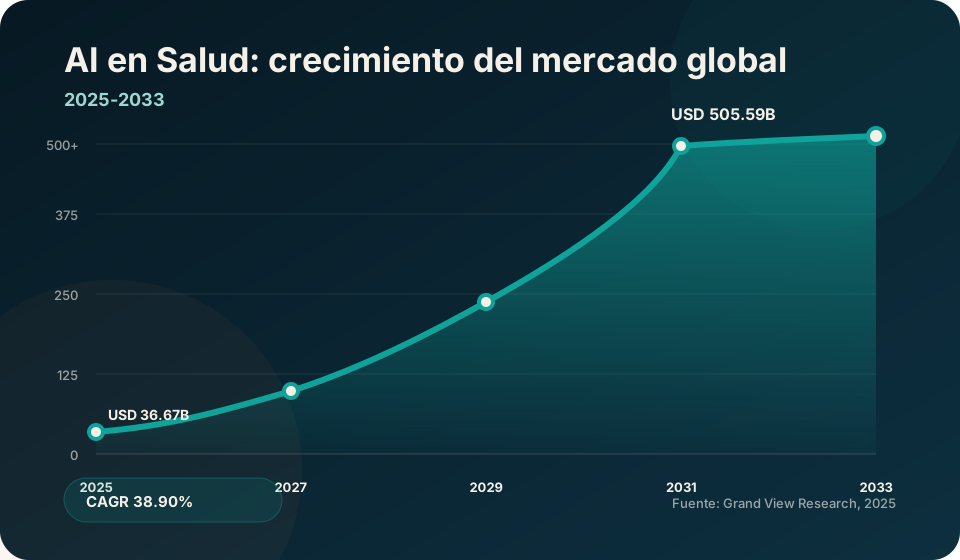
But those numbers have a very precise geography.
North America concentrated more than 54% of that market in 2025. Most investment accumulates where healthcare spending is high, digital infrastructure is consolidated, and technical capabilities exist to train, validate, and adapt models to local contexts. The World Economic Forum has consistently warned that the economic and social benefits of AI continue to accumulate in the Global North, mainly the United States, Europe, and China, while middle- and low-income countries watch from outside a development that in theory should benefit them.
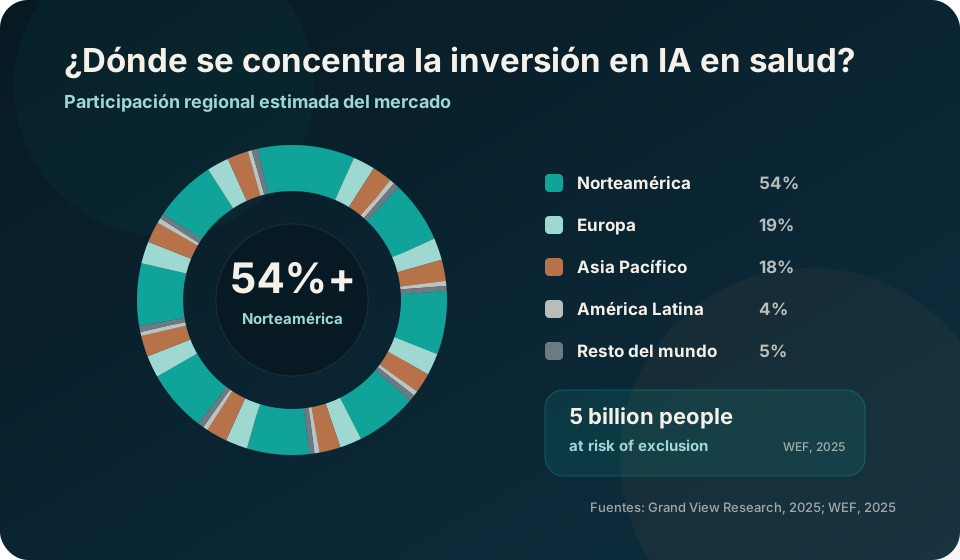
Across much of the Global South, access to AI technologies in healthcare is still incipient. Not because the problem does not exist, but because current models and data are trained on populations from high-income countries, not on the demographic and epidemiological realities of Africa, Central Asia, or Latin America. In October 2025, the WEF published an analysis with a title that leaves little room for interpretation: AI in healthcare risks could exclude 5 billion people. Five billion people could be left out, not for lack of need, but because the systems were built for another world.
Five billion people. That is not a minor statistic.
Two uncomfortable truths
The dominant narrative about AI in healthcare has a problem: it assumes technology is inherently equalizing. That a good algorithm is a good algorithm anywhere in the world. That assumption collides with reality in two concrete ways.
The first is that AI is not automatically equalizing. A 2025 review in Digital Health, which analyzed studies on AI in healthcare in the Global South between 2022 and 2025, documented that advances remain concentrated in the North, leaving the South at a significant disadvantage because of deficient infrastructure, biased training data, and limited local technical capacity. The WEF illustrates this with concrete examples: skin cancer detection algorithms trained mainly on light-skin images that perform worse on darker skin, or cardiovascular risk calculators built on European and American cohorts that under- or overestimate risk in African, South Asian, or Latin American populations. Not because the algorithm is necessarily bad, but because it was trained for another world.
The second is that the technology gap is fundamentally economic and political, not technical. Countries able to invest in data centers, digital talent, clinical integration, and regulated deployment are widening their competitive advantage in healthcare. Countries without that leverage are relegated to being consumer markets for technology developed in another context, for another population, with different problems. Not co-producers. Consumers.
What this means for practicing medicine in the South
Working in healthcare in Uruguay, Argentina, or any Latin American country means operating in a system with limited resources, uneven digital infrastructure, and an epidemiological burden that no model trained in the North fully knows.
That does not mean AI has nothing to offer. It means the way it is adopted matters as much as the technology itself. It matters who trains the models and with what data. It matters whether local capacity exists to validate, question, and adapt them. It matters whether there is a critical mass of professionals able to interpret them with epidemiological rigor and sociocultural context, not only technological enthusiasm.
Because in twenty-first-century clinical practice, access to a model is not enough. We need the resources and training to know when to trust it and when not to.
The question nobody wants to answer
Are we willing to redefine what it means to practice medicine when information is no longer the scarce resource, but the capacity to invest in technology is?
It is an uncomfortable question because it has no technical answer. It has a political one.
It means deciding whether AI in healthcare will become a tool for equity or a new way of concentrating advantages among those who already have them. It means asking what role public health systems, universities, and regulators play in an ecosystem dominated by private companies headquartered in another hemisphere. It means accepting that adopting technology without critical context is not modernization. It is dependency by another name.
That is not science fiction. It is health policy with real-world numbers.
And it is a conversation the Global South is still learning how to have.
Sine fumo et nugis.
Shared reading
Commentarii
This space is intended for brief contributions, questions, or critical readings about the article. For now, every submitted text is subject to editorial review before any publication.